
**ADSP-2183BST-115: A Comprehensive Technical Overview of a Legacy DSP Processor**
The ADSP-2183BST-115 stands as a significant milestone in the history of digital signal processing. As a member of Analog Devices' venerable ADSP-2100 family, this processor was engineered to deliver high performance for computationally intensive tasks in embedded systems. Even as newer architectures emerge, understanding this legacy component provides valuable insight into the foundation of modern real-time processing.
At its core, the ADSP-2183 is a **single-cycle instruction set** machine with a modified Harvard architecture. This design, featuring separate data and program memory buses, is fundamental to its performance, allowing the processor to fetch both an instruction and two data operands in a single cycle. The 'BST' suffix denotes a 16-bit fixed-point DSP, while the '-115' indicates a **maximum clock speed of 115 MHz**, enabling a core instruction cycle time of just 8.7 ns.
A key to its computational prowess is the inclusion of three independent computational units: an Arithmetic Logic Unit (ALU), a Multiplier/Accumulator (MAC), and a Barrel Shifter. These units operate in parallel, allowing the processor to execute a multiply-accumulate (MAC) operation—the cornerstone of DSP algorithms like filtering and Fourier transforms—in a single cycle. This results in a formidable **performance of 115 million MACs per second (MMACS)**.
The memory configuration is another critical strength. The ADSP-2183BST integrates 80 KB of on-chip RAM, configured as 16K words (24-bit) of program RAM and 16K words (16-bit) of data RAM. This on-chip memory is crucial as it runs at the full processor speed, eliminating wait states and creating a highly efficient **zero-wait-state execution environment**. This is a vital feature for guaranteeing deterministic, real-time performance in control loops and signal processing chains.
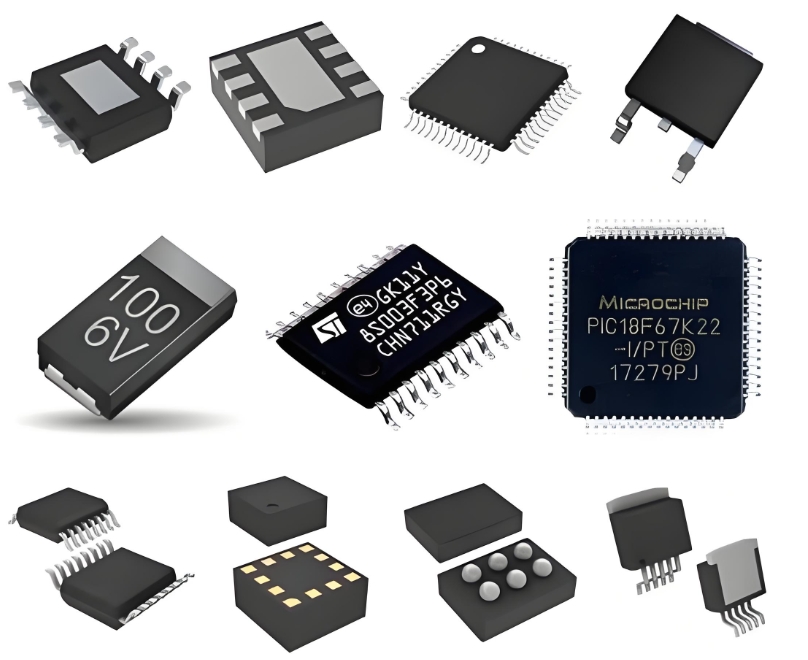
The 'BST' package is a 100-lead LQFP (Low-Profile Quad Flat Pack), making it suitable for space-constrained applications. Its integrated peripherals, including two serial ports, a programmable timer, and a host interface port, reduced the need for external components, simplifying system design and lowering overall cost.
This DSP was predominantly deployed in telecommunications infrastructure (e.g., modems, voice processing), automotive systems, industrial control, and high-fidelity audio processing. Its **robust architecture and deterministic operation** made it a reliable choice for a generation of engineers.
Despite its age, the ADSP-2183BST-115 remains in use today in legacy systems and long-lifecycle products, a testament to its solid design and the effectiveness of the ADSP-21xx platform.
**ICGOOODFIND**
The ADSP-2183BST-115 is a classic example of a highly integrated, high-performance fixed-point DSP. Its parallel architecture, abundant on-chip zero-wait-state memory, and single-cycle instruction execution established a benchmark for efficiency and deterministic real-time processing in its era, cementing its status as a legendary processor in the embedded world.
**Keywords:**
1. **Digital Signal Processor (DSP)**
2. **Modified Harvard Architecture**
3. **Multiply-Accumulate (MAC)**
4. **Zero-Wait-State Memory**
5. **Real-Time Processing**

